Spoilers ahead for The Weight.
Padraic McKinley’s The Weight hits theaters this weekend, and features a stellar cast of familiar faces. It remains to be seen if fans think of it as one of Ethan Hawke’s best movies, but the 5-time Oscar nominee gives an incredible performance throughout its 113-minute runtime. Both he and the movie’s director spoke to CinemaBlend about the movie’s wildly satisfying ending.
Ethan Hawke did some dangerous stunts in The Weight, and after his character Samuel Murphy survived his dangerous journey across the wilderness, he and his surviving companions have a juicy last confrontation with Russell Crowe’s Warden Clancy. As you can see above, I asked both the cast and filmmaker about that finale, with Julia Jones offering a peek behind the curtain about that final Clancy scene. As she revealed:
We shot that very, very early on. I think that was my first day of work or second, first or second. It set the tone for the whole movie because it was a super high stakes scene, and it was Ethan and Russell and we’re all in there. And we just got to watch them go back and forth. And part of it was like on a performance level, but also it’s the stakes of the movie. I mean, the whole movie is kind of in that scene and we’re there watching it.
How wild is that? Moviemaking is a tricky thing, and oftentimes actors are tasked with shooting scenes out of chronological order. The big ending scene with Russell Crowe was shot early into the Dexter: New Blood star‘s tenure playing Anna, and it sounds like it helped Jones zero in on the movie’s tone and story as a whole. Talk about a happy accident.
Ethan Hawke also spoke about that big scene with Crowe, and had similar feelings about how shooting helped to set up the cast and crew of The Weight for success. As the Black Phone star told me:
It was kind of like losing your virginity or something. Every movie has that where, it has one difficult scene where then you’re really making the movie. There’s all this rehearsals and prep and you even start shooting and you’re doing a couple shots. But then you have to do something difficult before everybody feels like we’ve set sail.
That’s certainly one way of looking at things. But the analogy does make sense; just like losing one’s virginity, filming the first complicated scene in any movie can be filled with nerves and high stakes. It can also bring people together, and it appears that’s exactly what happened in the epic final confrontation in The Weight.
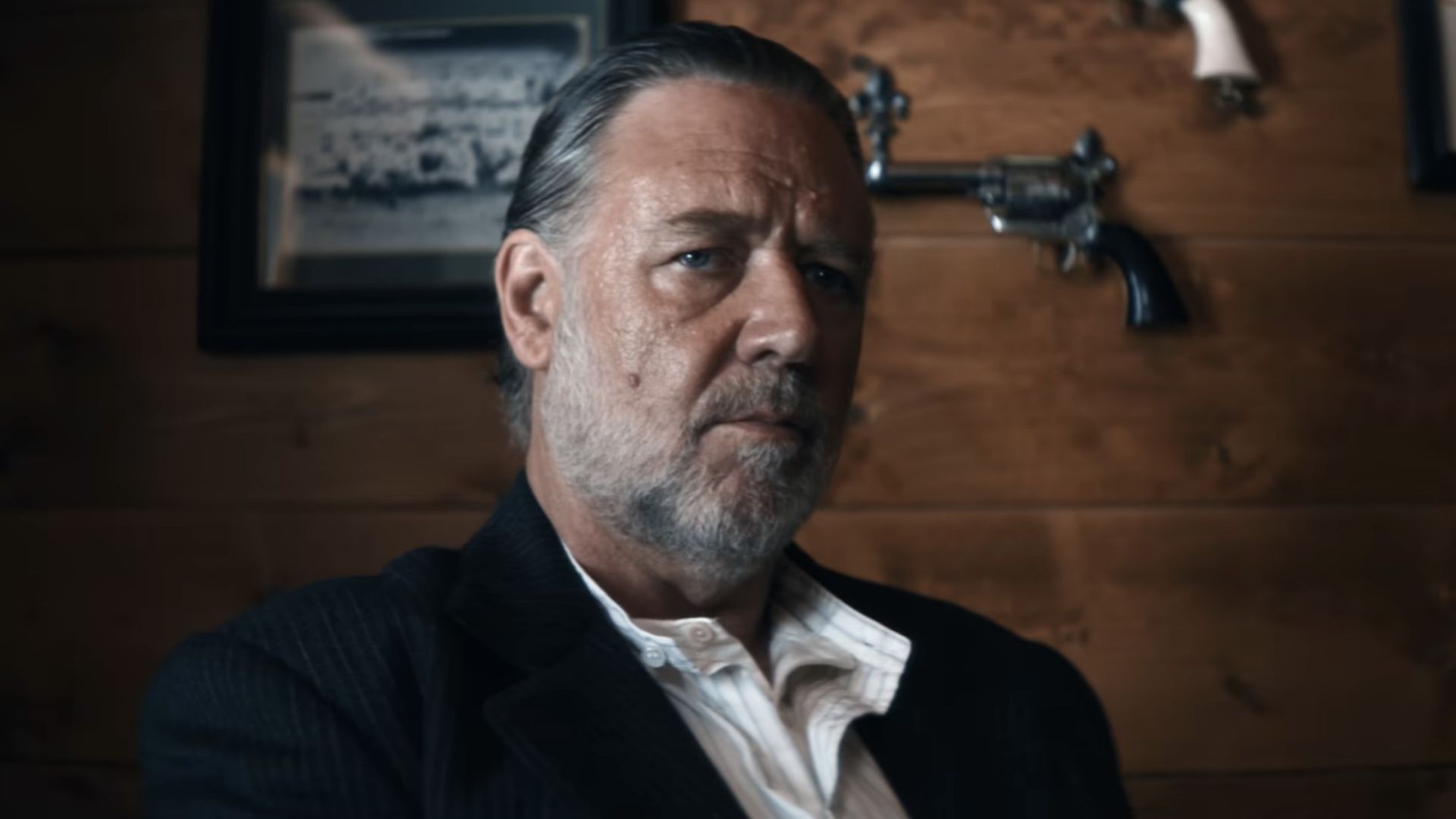
After Samuel, Anna, and their friends make a life-changing deal with Crowe’s Clancy, we get the final moments of the film. Namely when Ethan Hawke’s protagonist is finally free from his sentence, and able to reunite with his daughter Penny. The movie ends just as it begins, with Samuel and Penny driving together and laughing. Director Padraic McKinley spoke to me about crafting that full circle moment, telling me:
I looked at the movie kind of like a trough. You know, we start with Penny and we, then we meet Clancy, Russell Crowe’s character, and then we get to Taggart and we go on this journey. Then we meet Taggart, then we meet Clancy, and then we finally come back to Penny. So there’s a natural sort of secular shape to the film. But what was important to me was that when we see them, we see them with joy.
Samuel and his daughter once again driving into the sunset together was an obvious example of the cyclical nature of The Weight. We also see character interact with him in reverse order during the second half of the film, which really wraps things up in a satisfying way.
Joy isn’t something that Hawke’s character experiences much of throughout the movie’s runtime. He nearly dies a number of times, and is basically beat to pulp prior to the aforementioned scene with Russell Crowe. But The Weight‘s final moments feature laughter between a father and his daughter, as the pair drive off into their happy ending. Later in our conversation, McKinley spoke about the film’s final moments, and how he connects with it on a personal level. He told me:
At the end of the day, what was really important became our kind of north star was just getting her teddy bear back and putting it, getting that teddy bear, getting in the car. And it’s funny because as I’ve got two daughters and, and especially when they were young, it was one thing, when they got older it was another thing. But driving with my daughters is the almost, most natural way to get sort of talking. And, you know, the world passing by and having just, you know, just cruising around LA. It resonated with me and I though it was a, just a nice way to, you know, wrap it up as well as start the film.
Lots of kids and parents connect while driving, and in this way The Weight‘s conclusion brought the period piece and the modern world closer together. On top of the good guy winning in the end, this full circle moment also really helped the movie stick the landing. It’s a wonderful ride, and the action sequences were legitimately thrilling. Still, the happy ending was the cherry on top.
The Weight is in theaters now as part of the 2026 movie release list. It’s always a good day when Ethan Hawke has a new movie out, and this one accomplished a ton with an indie budget.